If you are thinking about letting your property in York, one of the first questions you are likely to ask is: how much rent can I achieve?
Whether you are considering letting your home for the first time, have an existing investment property or are reviewing the rent on a property you already let, understanding its potential rental value is an important starting point.
York has a varied rental market, with demand for different types of property across the city and surrounding villages. However, there is no single figure that can accurately determine what every property is worth. Two houses with the same number of bedrooms can achieve quite different rents depending on their location, condition, layout and the type of tenant they are likely to attract.
At Martin & Co York, we have been letting and managing properties across the city since 2003. In this article, we explain what influences rental values, how to get a realistic idea of what your property could achieve and why a professional local rental valuation is so important.
1. What is the average rent in York?
Looking at average rents is a useful way to understand the wider York rental market, although it is important to remember that averages do not tell the whole story.
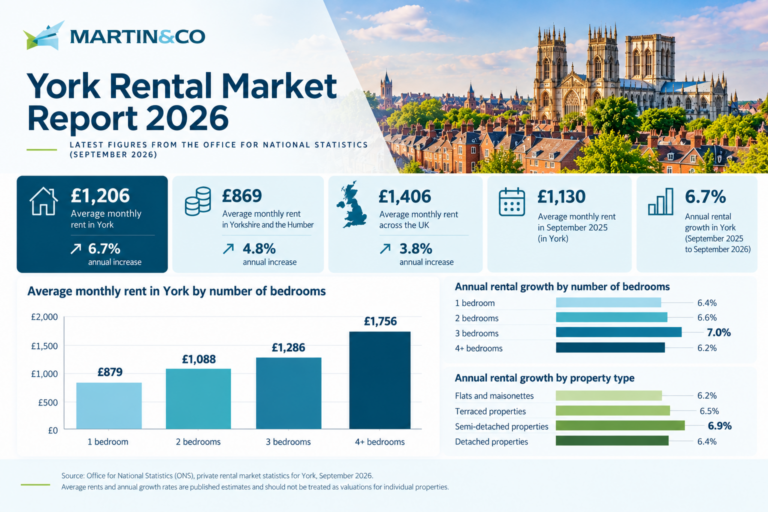
According to the Office for National Statistics, the average monthly private rent in York was £1,206 in September 2026. This represented an increase of 6.7% compared with September 2025.
The latest published figures also provide a useful indication of average rents by property size:
| Property size | Average monthly rent |
|---|---|
| One bedroom | £879 |
| Two bedrooms | £1,088 |
| Three bedrooms | £1,286 |
| Four or more bedrooms | £1,756 |
These figures provide a useful snapshot of the wider market, but they should not be treated as a rental valuation for an individual property.
For example, a modern two-bedroom apartment in a popular central location may achieve considerably more than the city-wide average, while an older property requiring updating may achieve less.
The same applies to houses. A well-presented three-bedroom property in a desirable residential area, with parking and a good-sized garden, may attract a different level of rent from a similar-sized property in another part of the city.
The important thing is to understand how your particular property compares with others currently available and, just as importantly, properties that have recently let.
2. Location makes a significant difference
Location is one of the most important factors when assessing how much rent a property could achieve.
York has a wide variety of neighbourhoods, each attracting different types of tenants. Some people want to be within walking distance of the city centre, while others prioritise schools, transport links, parking, green spaces or access to local amenities.
At Martin & Co York, we let properties across the city, including York city centre, South Bank, Fulford, Acomb, Heworth, Huntington, Rawcliffe, Holgate and the Hull Road area. We also cover surrounding villages and a wider area extending to Selby, Beverley and Hull.
Each location has its own characteristics and appeal. For example, proximity to the railway station, York Hospital, the University of York, the city centre or major employment locations may influence the type of tenant interested in a property.
Even within the same neighbourhood, individual streets and property positions can make a difference. Parking, outlook, traffic, access to amenities and the immediate surroundings can all influence a property's appeal.
This is why a local understanding of the market is so important. A rental valuation should take account of the specific location rather than relying solely on general averages for York.
3. Property size, layout and type
The size and type of property will naturally influence its rental value, but the number of bedrooms alone does not determine what it can achieve.
A two-bedroom apartment, for example, may appeal to professional couples, individuals or sharers, depending on its layout and location. A two-bedroom house with a garden and parking may attract a different audience.
Similarly, a three-bedroom house with two reception rooms may appeal to families looking for additional living space, while a property with a more open-plan layout may be better suited to professional tenants.
When assessing rental value, we consider factors such as:
The number and size of bedrooms.
The number and arrangement of reception rooms.
Bathroom facilities and the overall layout.
Storage space and practical living arrangements.
Parking, garage or off-street parking availability.
Gardens, balconies, terraces and other outside space.
Whether the property is suitable for families, professionals or sharers.
A property that makes particularly good use of its available space can sometimes achieve a stronger rent than a larger property with a less practical layout.
4. Condition, presentation and specification
The condition and presentation of a property can have a considerable impact on both the rent it achieves and the level of interest it generates.
Tenants generally want a property that is clean, well-maintained and ready to move into. A modern kitchen or bathroom, good decoration, quality flooring and well-maintained fixtures and fittings can all help a property stand out.
This does not necessarily mean that a landlord needs to undertake extensive improvements before letting. In many cases, relatively straightforward work such as fresh decoration, repairing minor defects, improving lighting or replacing tired flooring can make a noticeable difference.
The overall specification is also important. Heating, glazing, broadband availability, appliances and energy efficiency may all influence how attractive a property is to prospective tenants.
At Martin & Co York, we can advise landlords on whether improvements are likely to make a meaningful difference to rental value or simply represent unnecessary expenditure.
The objective should be to present the property to the right standard for its likely rental market, rather than spending money on improvements that may not be reflected in the rent.
5. Furnished or unfurnished – which achieves more rent?
Whether to let a property furnished or unfurnished is another important consideration.
There is no universal answer, as it depends on the type of property, its location and the tenants it is likely to attract.
In some parts of York, particularly where properties appeal to professional tenants or people relocating to the city, furnished accommodation may be attractive. In other situations, tenants may prefer an unfurnished property so they can bring their own furniture and make it feel like home.
Furnishing a property involves an initial investment, as well as the ongoing responsibility of maintaining and eventually replacing furniture and appliances. It is therefore important to consider whether any additional rent is likely to justify that cost.
We would generally recommend considering the likely tenant market before making a decision. Furnished accommodation is not automatically more valuable, and a well-presented unfurnished property can be just as attractive to the right tenant.
6. What is the current demand for rental properties in York?
Rental demand can change throughout the year and can vary between different types of property.
York attracts a broad range of tenants, including professionals working in the city, families, people relocating for employment, university-related tenants and those moving within the local area.
Demand is influenced by a number of factors, including employment opportunities, the availability of suitable homes, affordability and the time of year.
Some types of property may attract strong interest from tenants at particular times of the year, while others have a more consistent market.
It is also important to distinguish between general interest in rental properties and genuine demand for a particular property at a particular price. A property may generate plenty of enquiries when first advertised, but that does not necessarily mean the asking rent is realistic.
At Martin & Co York, we look at the level of interest in comparable properties, the type of enquiries being received and how quickly suitable properties are letting. This helps us assess how a property should be positioned in the current market.
7. How do you know if your asking rent is realistic?
One of the most important decisions when letting a property is setting the initial asking rent.
It is understandable that landlords want to achieve the best possible return, but setting the rent too high can sometimes work against them.
If a property is priced above its realistic market value, it may attract fewer enquiries, receive less viewing interest and remain available for longer. This can ultimately result in the landlord having to reduce the asking rent.
A property that is priced appropriately from the outset is more likely to generate relevant interest and attract suitable prospective tenants.
When assessing the asking rent, we consider:
Comparable properties currently being marketed.
Similar properties that have recently let.
The property's location, condition and specification.
The likely tenant market.
The level of competition from other available properties.
The time of year and current demand.
It is particularly important to look beyond the advertised rents of other properties. An asking rent does not necessarily represent the rent that a landlord ultimately achieves.
Understanding what comparable properties have actually let for, and how much interest they generated, can provide a much more useful indication of achievable rental value.
8. Should I improve my property before letting it?
If your property is not currently presented to the standard you would like, you may be wondering whether it is worth carrying out improvements before putting it on the rental market.
In some cases, improvements can help achieve a higher rent, attract a wider range of tenants or reduce the time it takes to find somebody suitable.
However, it is important to distinguish between improvements that genuinely add value and those that simply involve spending money.
For example, replacing a dated bathroom or kitchen may improve the property's appeal, but the cost may not be justified by the additional rent it generates. On the other hand, dealing with obvious maintenance issues, improving decoration and ensuring the property is clean and well presented are often worthwhile.
We would recommend discussing any proposed work with a letting agent before committing to significant expenditure.
At Martin & Co York, we can provide practical advice on how a property is likely to be received by prospective tenants and whether any improvements are likely to make a difference to its rental prospects.
9. Why should I arrange a professional rental valuation?
Online rental calculators and property websites can provide a general indication of rental values, but they cannot take account of every detail that makes your property different.
A professional rental valuation involves looking at the property itself, its location, condition, layout and specification, alongside comparable properties and current market conditions.
It also provides an opportunity to discuss the type of tenant your property is likely to attract, how it should be marketed and whether any preparation is advisable before it is advertised.
At Martin & Co York, we believe that an accurate rental valuation should be based on local experience and a realistic assessment of the market.
We will consider what similar properties are achieving, the level of competition and the likely demand for your particular property. We can then provide advice on an appropriate asking rent and the best way to bring it to the market.
A rental valuation is also a useful opportunity to discuss the letting process, the different management services available and the responsibilities involved in becoming a landlord.
How much rent could your property achieve with Martin & Co York?
If you are considering letting your property, we would be delighted to provide an honest and realistic assessment of its rental value.
At Martin & Co York, we have been helping landlords across York and the surrounding areas since 2003. Our local experience gives us an understanding of the different neighbourhoods, the types of tenants they attract and the factors that influence rental demand.
Whether you own a city centre apartment, a family home in one of York's residential areas or a property in one of the surrounding villages, we can help you understand its rental potential.
We can also discuss the level of support you require, from finding a tenant through to fully managed property management, with management packages tailored to suit individual landlord requirements.
Martin & Co York
64 Micklegate
York
YO1 6LF
Telephone: 01904 648888
Website: Martin & Co York
Contact us to arrange a rental valuation and find out how much rent your property could achieve.