Keighley has always been a town where plenty of people rent. Rows of stone terraces built for mill workers, flats above the shops on North Street and Cavendish Street, and a steady stream of people coming in for jobs at Airedale Hospital or commuting down the line to Leeds and Bradford all keep the rental market ticking over.
If you own a property in the BD21 postcode and you’re thinking about letting it, this guide covers what homes are renting for right now, the sort of return you can expect, and the jobs that need doing before a tenant moves in. If your property is up the valley in Silsden, Steeton or Cross Hills, our separate landlord guide for those villages will suit you better, as rents and buyer prices there behave quite differently.
Who rents in BD21
Around a quarter of homes in the BD21 district are privately rented, 25.6% according to the latest Census figures. Another 12.2% are social housing, and the rest are owner-occupied, split between people who own outright (33.9%) and those with a mortgage (28.0%). (Source: ONS Census 2021 tenure data via PropertyData, October 2026.)
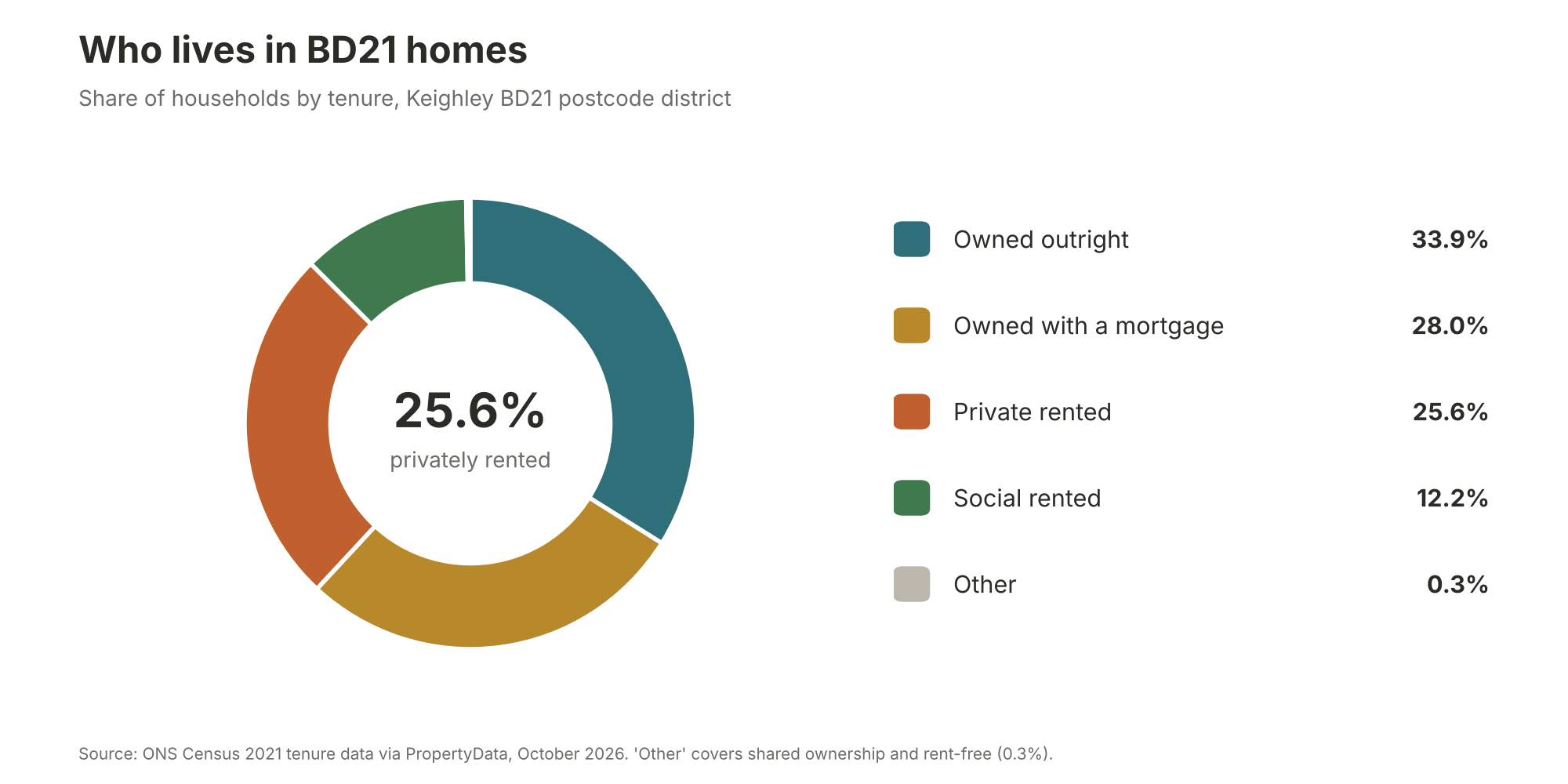
That one-in-four figure matters for landlords in two ways. It tells you there is an established pool of tenants who expect to rent locally rather than buy. It also means your property is competing with a good number of other lets, so presentation and pricing count.
The housing stock shapes what tenants are looking for too. Terraced houses make up 39.6% of homes in BD21, with semi-detached homes at 33.3% and flats at just under 11% across purpose-built, converted and commercial buildings. (Source: ONS housing stock data via PropertyData, October 2026.) In practice, the typical Keighley tenant is either a single person or couple looking at a town-centre flat, or a family looking at a two or three-bedroom terrace or semi.
What Keighley homes rent for
We looked at the 39 homes being advertised to let across the BD21 district in October 2026. The average asking rent was £159 a week, roughly £689 a month. (Source: Rightmove and Zoopla listings via PropertyData, October 2026.)
Broken down by size, the averages come out as:
- One bedroom: about £506 a month (10 listings)
- Two bedrooms: about £733 a month (18 listings)
- Three bedrooms: about £767 a month (8 listings)
(Source: Rightmove and Zoopla listings via PropertyData, October 2026. Monthly figures calculated from weekly asking rents.)
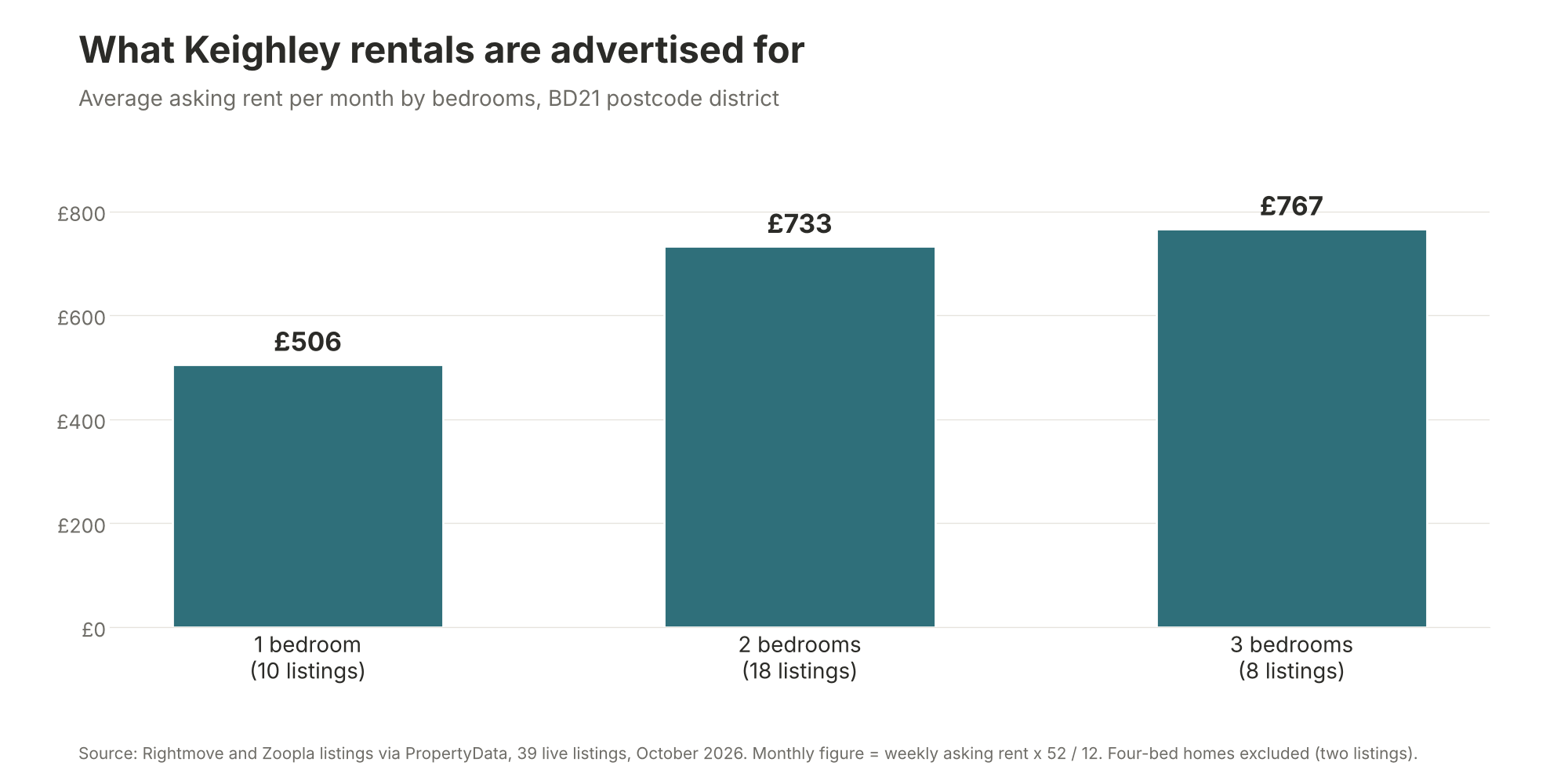
Two things stand out. All ten of the one-bedroom homes on the market were flats, most of them in or close to the town centre. And the gap between a two-bedroom and a three-bedroom home is much smaller than you might expect, around £34 a month. A lot of three-bedroom terraces in BD21 are tight on space, so tenants don’t always see the third bedroom as worth paying much more for. If you own a two-bedroom house with a decent second bedroom, a garden or off-street parking, you are often competing on level terms with bigger homes.
The spread is wide, though. The middle 70% of listings sat between £115 and £196 a week. (Source: Rightmove and Zoopla listings via PropertyData, October 2026.) Where your home lands in that range comes down to the street, the condition and what is included.
What return can you expect?
The average gross yield for long lets across BD21 is 5.0%, based on 140 data points. (Source: PropertyData, October 2026.)
Gross yield is simply annual rent divided by the property’s value, before any costs. As a rough sum, a home bought at the BD21 average sold price of £130,290 (source: HM Land Registry via PropertyData, 273 sales between April 2025 and August 2026) and let at the two-bedroom average of £733 a month would bring in £8,796 a year, a gross yield of around 6.8%.
That is higher than the district average because cheaper terraces tend to produce stronger yields than larger homes on the edge of town. It is also a gross figure. Once you take off letting fees, insurance, repairs, safety certificates and any months without a tenant, the net return is lower. If you’re working out whether to keep a property as a rental or sell it, run the numbers on your actual home rather than an average.
The rules every Keighley landlord needs to know
Letting a property in England changed on 1 May 2026, when the main parts of the Renters’ Rights Act came into force. The headline points for landlords are:
- Tenancies are now periodic. New lets no longer run on fixed terms. The tenancy rolls on month by month until either side ends it properly.
- Section 21 has gone. You can no longer end a tenancy without giving a reason. If you need the property back, for example to sell or move a family member in, you have to use one of the set grounds and give the right notice.
- Rent increases are once a year. Increases follow a formal process, and tenants can challenge a rise they feel is above the market rate.
Alongside those changes, the usual obligations still apply:
- A gas safety certificate every 12 months if the property has gas appliances.
- An electrical installation condition report (EICR) at least every five years.
- An Energy Performance Certificate with a rating of E or above for most lets.
- Working smoke alarms on every floor and carbon monoxide alarms where there is a fixed combustion appliance.
- Deposit protection in a government-approved scheme within 30 days, with the prescribed information given to the tenant.
- Right to rent checks on every adult tenant before the tenancy starts.
It is also worth checking with Bradford Council whether any licensing scheme covers your street before you advertise.
If you’re not sure how up to date your paperwork is, our free landlord compliance quiz takes a couple of minutes and flags the areas to look at.
Getting a Keighley property ready to let
Older stone terraces make up a big part of the rental stock in town, and they come with their own to-do list.
Damp and ventilation. Solid stone walls and cellars are prone to condensation if a house isn’t heated and ventilated properly. Extractor fans in the kitchen and bathroom, and trickle vents on windows, go a long way. Tenants notice black mould quickly, and it is a common cause of complaints.
Heating. A modern combination boiler and thermostatic radiator valves make a real difference to running costs, which matter to tenants as much as the rent. If your EPC is close to the E boundary, loft insulation and LED lighting are inexpensive ways to lift it.
Presentation. Neutral walls, clean carpets or flooring and good photos taken in daylight help a listing stand out among the other homes on Rightmove and Zoopla. Tenants searching in Keighley often filter by parking and garden, so if you have either, make sure it’s clear in the description.
Furnished or unfurnished. Most family homes in Keighley let unfurnished. One-bedroom town-centre flats sometimes do better part furnished, especially for tenants relocating for work.
Let it yourself or use an agent?
Some landlords are happy to manage everything themselves. Others prefer to hand over the day-to-day side, especially now that the rules around notice, rent increases and repairs are more detailed than they used to be.
At Martin & Co Keighley we offer a let-only service, where we find and reference the tenant and set up the tenancy, and a fully managed service, where we also collect the rent, arrange repairs with local trades, carry out inspections and keep certificates up to date. If this is your first let, we’ll walk you through each step.
If you’re weighing up whether to let or sell, our guide to Keighley vs Aire Valley village house prices shows how town prices compare with the villages, which can help you decide.
Book a free valuation
Whether you’re ready to let now or just want to know your options, the first step is an honest figure for your home. We’ll tell you what it should rent for, what it would sell for, and which route makes more sense for you.
Book a free home valuation with Martin & Co Keighley today. Call 01535 669588 or email [email protected].