Autumn is the quiet workhorse of the property calendar. The summer holidays are behind everyone, the schools are back, and buyers who spent August looking at campsites rather than floorplans start looking properly again. If you are thinking about selling your home in Keighley before the year turns, the next few weeks are the window that matters.
The catch is that most people underestimate how long the whole thing takes. Not the marketing, which is the visible part, but the eleven or twelve weeks of solicitors’ letters, search results and mortgage paperwork that follow an accepted offer. Sellers who list in September and expect to be unpacking in a new house by Christmas are usually a month or two out.
This guide walks through the whole process week by week, using real figures for Keighley and the wider market rather than general advice that could apply to anywhere. It covers what your home is likely to be worth, how long you should expect to wait for an offer, where the legal stage tends to slow down, and what to do if November arrives and nothing has happened.
Why autumn is a sensible time to list in Keighley
Rightmove’s own research on the best months to sell puts February and March at the top, with around 66.3% of homes listed in those months going on to complete. Autumn does not quite match that, but it holds up well: Rightmove notes that autumn months usually see an increase in home-moving activity through to early November, helped along by the post-holiday return to normal routines. (Rightmove seller guide)
The months to be wary of are the ones straight after. November and December carry the longest lead times to completion of any point in the year, according to the same research. That is not a reason to avoid selling in the autumn. It is a reason to get your listing live in September or early October rather than drifting into late November and hoping.
The wider backdrop matters too. Rightmove’s June 2026 House Price Index recorded an average of 65 homes per agent, which it described as historically high for the time of year, alongside buyer demand down 10% on the same point in 2025. More competition and slightly thinner demand does not mean homes are not selling. It means the ones that sell are the ones priced sensibly from day one. (Rightmove House Price Index, June 2026)
Weeks 0 to 2: valuation, paperwork and the jobs worth doing
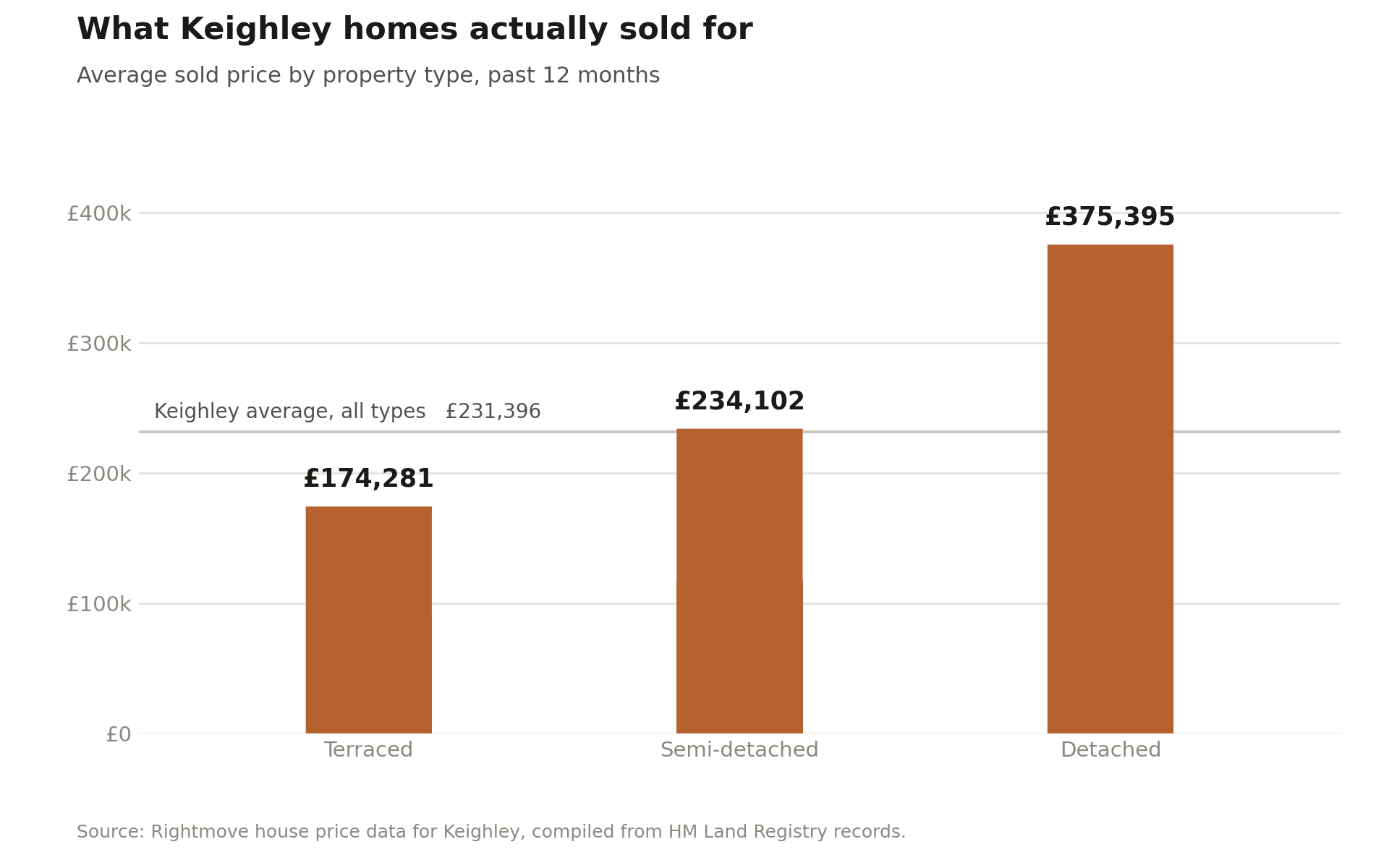
Everything starts with an accurate figure, and in Keighley that figure varies enormously depending on what you own and where. Rightmove’s sold price data puts the overall Keighley average at £231,396 over the past year, up 4% on the year before and 10% above the 2023 peak of £210,596. Underneath that headline sits a wide spread: terraced homes averaged £174,281, semi-detached £234,102, and detached £375,395. (Rightmove house prices, Keighley)
Postcode makes a real difference. Zoopla’s figures for BD21, which covers central Keighley, show an average sold price of £136,247, with terraced homes at £111,003 and detached at £280,278. That is a very different market to the one you find out towards Silsden, Steeton and Riddlesden in BD20, or up in Haworth and Oakworth in BD22. Anyone quoting you a single “Keighley price” without asking which street you are on is guessing. (Zoopla sold house prices, BD21)
Use these two weeks for the admin nobody enjoys. Order your EPC if the existing one has expired, dig out the FENSA certificates for the windows, find the building regulations sign-off for the loft conversion, and locate your title deeds or land registry details. Solicitors ask for all of this eventually, and the sellers who have it ready are the ones whose sales move fastest. The decluttering and the fresh paint matter as well, but the paperwork is what saves you weeks later on.
Weeks 2 to 11: on the market and finding a buyer
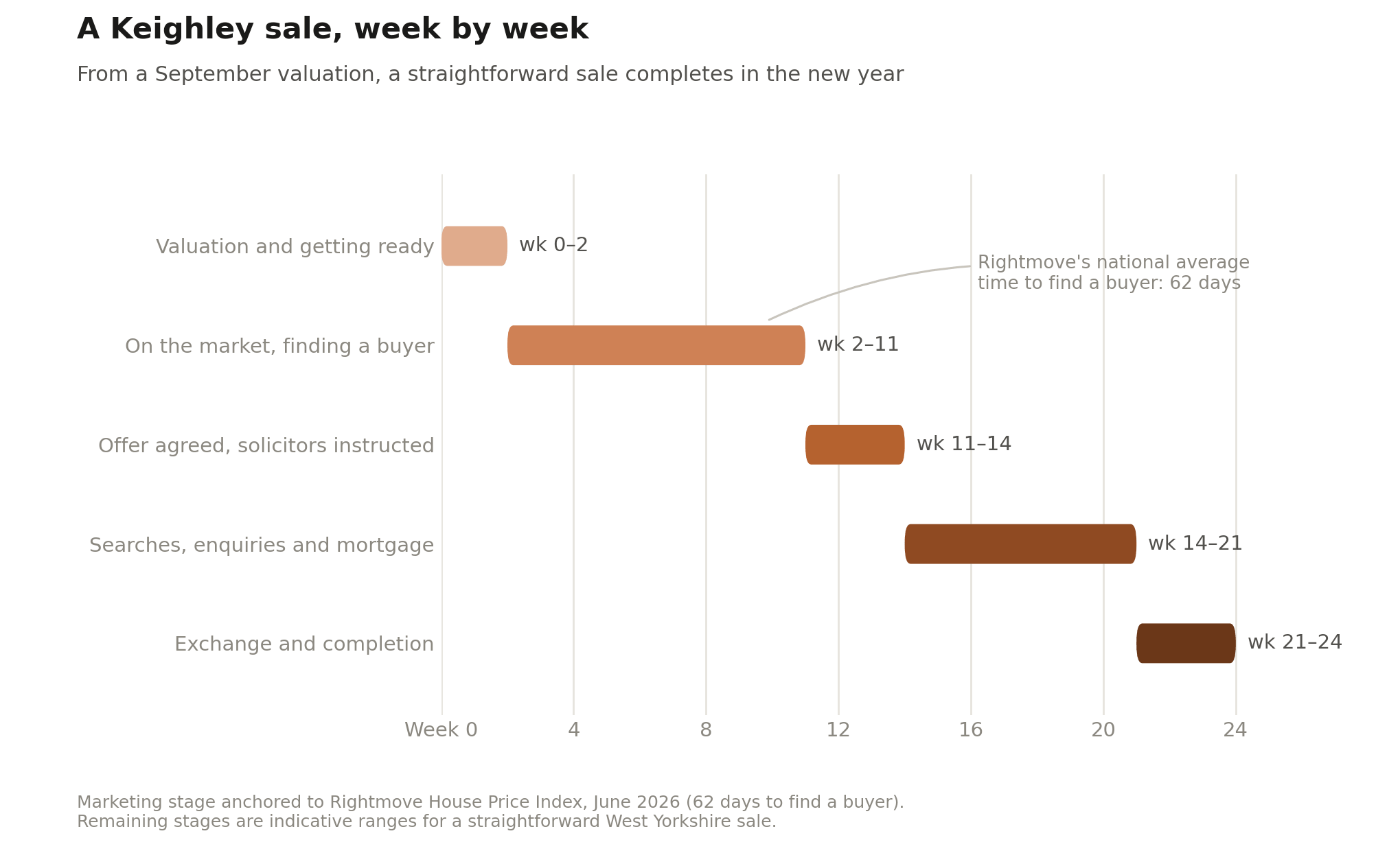
The average time to find a buyer nationally was 62 days in Rightmove’s June 2026 index, which works out at roughly nine weeks. Some Keighley homes go far quicker, particularly well-presented terraces in the £120,000 to £180,000 bracket where first-time buyer demand is steady. Larger detached houses in the outlying villages typically take longer, simply because the pool of buyers is smaller. (Rightmove House Price Index, June 2026)
Autumn brings a practical problem that summer does not: light. The clocks go back on 25 October 2026, and after that your evening viewings are happening in the dark. Book the photographs early, ideally on a bright morning in the first fortnight, and get exterior shots of the garden while there is still colour in it. If your listing goes live in November with dim photos taken at four in the afternoon, you have handed buyers a reason to scroll past.
Price is the lever that does the most work in a market with this much stock on it. Rightmove’s 2026 forecast is for new seller asking prices to end the year around 2% higher, and its own advice to sellers is blunt: price realistically from the start, because competitive pricing is what secures a sale when buyers have plenty of choice. A home that launches 8% over its realistic value and gets reduced twice in six weeks usually ends up selling for less than one that was priced properly on day one. (Rightmove 2026 house price forecast)
Weeks 11 to 21: the legal stage, where most of the time goes
Once you accept an offer, we issue a memorandum of sale to both solicitors and both agents, and the clock restarts on a process you have far less control over. Your solicitor sends out the contract pack. The buyer’s solicitor applies to Bradford Council for local authority searches, orders drainage and water searches, and commissions an environmental report. In a former mill town like Keighley, coal mining and historic industrial land searches come up more often than they do elsewhere, and they can add time.
Meanwhile, the buyer’s lender instructs a mortgage valuation. If the valuer comes back at less than the agreed price, the offer gets revisited. This happens more often in areas with a wide spread of property values, which describes Keighley precisely, and it is another argument for pricing accurately rather than optimistically at the start.
Then come the enquiries. The buyer’s solicitor raises questions on anything the contract pack did not cover, and each round of questions takes a week or two to answer. This is the point where the seller who found their FENSA certificates back in week one gets rewarded. Realistically, budget ten to twelve weeks from accepted offer to being ready to exchange on a straightforward freehold sale, and longer if there is a chain above or below you.
Weeks 21 to 24: exchange, completion and being honest about Christmas
Exchange of contracts is the moment the sale becomes binding, and completion usually follows one to two weeks later, on a date everybody in the chain agrees. Between the two, you need to arrange removals, get final meter readings, redirect your post and hand over keys. None of it is complicated. All of it takes longer than you think when it lands in the same fortnight as Christmas.
Here is the honest arithmetic. A valuation in the first week of September, nine weeks to find a buyer, and eleven or twelve weeks of conveyancing lands you at completion in late January or early February. To be in a new home before Christmas 2026, you needed to be on the market in June. That is not a reason to wait until spring. It is a reason to set the right expectation now and stop measuring the sale against a deadline it was never going to meet.
You can compress it. Instructing your solicitor at the point of listing rather than at the point of offer saves one to two weeks. Getting your management pack ordered early on a leasehold flat saves more. Choosing a buyer with a mortgage offer already in principle, rather than the highest bidder who has not spoken to a lender, often saves a month. A good agent will talk you through those trade-offs rather than simply passing on the biggest number.
If it gets to November and you still have no offer
First, look at the viewing numbers rather than the enquiry numbers. Plenty of viewings with no offers usually points at something in the property itself, whether that is a room used as storage, a tired kitchen or a smell you have stopped noticing. Very few viewings from a decent number of portal clicks almost always points at price.
Second, resist the urge to withdraw and relist in January “when the market picks up”. You will be competing with everyone else who had the same idea, and Rightmove’s data shows the strongest completion rates land in February and March, which means those listings need to be live and established by then, not brand new. A well-judged reduction in mid-November often works better than four months of silence.
Third, review the photography and the copy. Listings that launched in bright September light and are still running in December can look out of step. Refreshing the main image, reordering the photo set and rewriting the first two lines of the description costs nothing and gives your listing a second run at buyers who scrolled past the first time.
Book a free valuation with Martin & Co Keighley
If you are weighing up whether to sell this autumn, the sensible first step is finding out what your home is actually worth today rather than what a portal estimate says. Our Keighley team, based at 4 North Street, works across central Keighley, Bingley, Silsden, Steeton, Haworth, Oakworth, Riddlesden and the Worth and Aire Valleys, and we know how differently those markets behave.
A valuation with us is free, takes around half an hour, and comes with no obligation to instruct. You will get a realistic price, the recent comparable sales behind it, an honest view on how long your particular property is likely to take, and a plan for the weeks ahead. If the answer is that you would be better off waiting until spring, we will tell you that too.
Book your free home valuation, visit our Keighley branch, or call the Keighley office on 01535 669588. You can also see what is currently for sale in Keighley to get a feel for what you would be competing with.